

What Makes a Yard Good for Bees? A Practical Guide to Hive Landscaping in NC
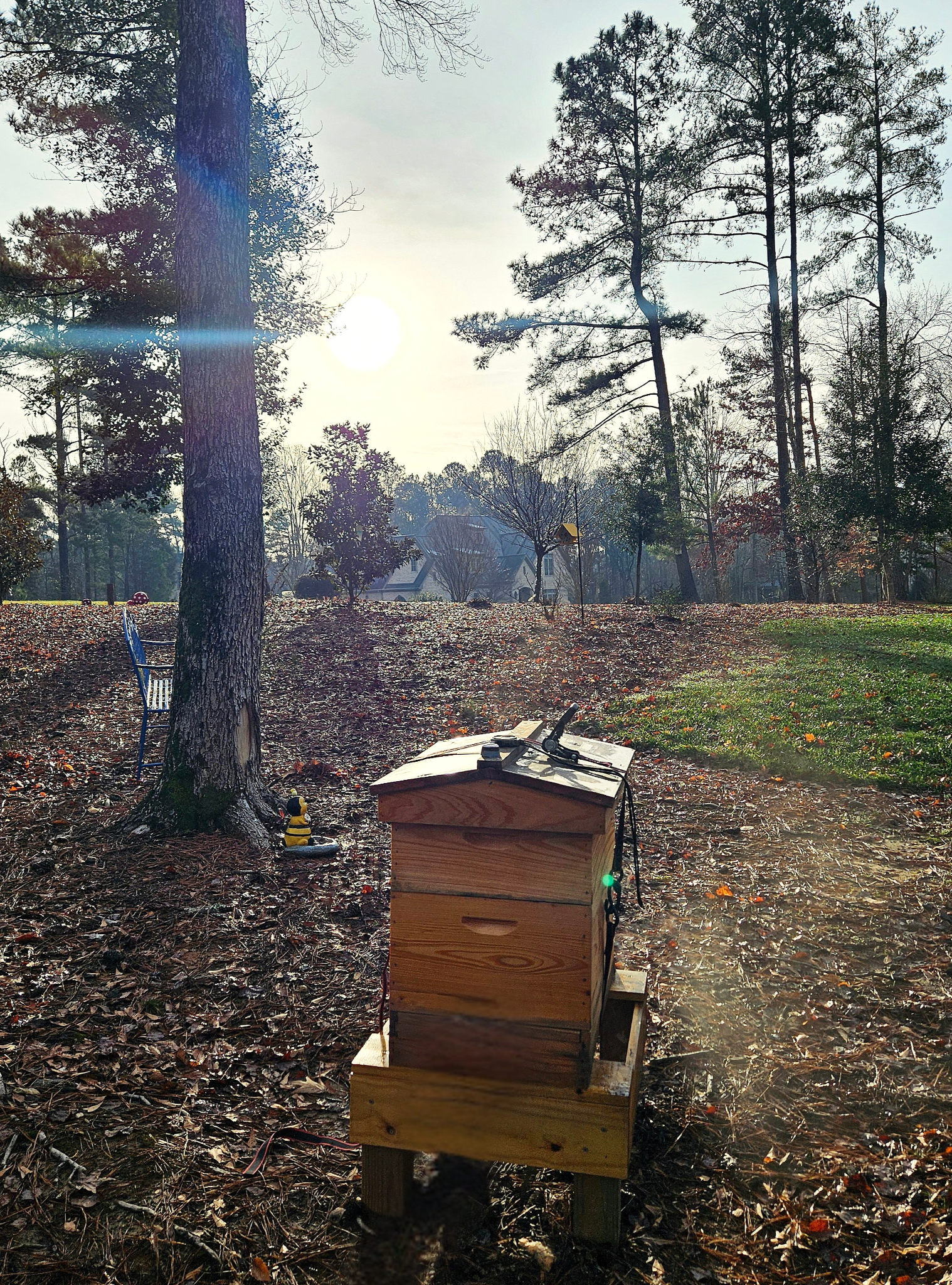
"A managed honey bee hive placed against a fence line in a North Carolina backyard."
We get asked a version of the same question all the time: is my yard big enough for a beehive? The honest answer is that size is rarely the deciding factor. What actually makes a yard good for bees has more to do with what’s in it — and around it — than with how much of it there is.
What does a honey bee actually need from a yard?
A managed hive in a backyard isn’t a wild colony scavenging across whatever it can find. It’s a stable population of around 40,000 to 60,000 bees that needs reliable access to a few specific things. From years of installing hives at homes across the Triangle and Charlotte, we’ve found that four factors matter more than anything else:
Forage — what’s blooming in your yard and within roughly three miles of it
Sun — how much direct light the hive gets, and when
Placement — where in the yard the hive sits, and what the bees’ flight path looks like
The human factor — your routines, your neighbors, your access for inspections
Yard size doesn’t make the list. It’s a proxy people reach for when they’re really asking about one of the four above.
Why does forage matter more than yard size?
A honey bee will travel up to three miles from her hive looking for nectar and pollen. That radius, roughly 28 square miles, is the colony’s actual foraging territory. Your yard is one small slice of it. What happens at the edges of that radius matters at least as much as what happens in your own grass.
This is why two very different setups can both work. We have one host with a tiny yard in downtown Durham who keeps a hive squeezed in high beside the chicken pen. Access to it is sketchy at best, but flowering trees and shrubs in the surrounding blocks have been carrying that colony for years. We have another host in a rural part of North Carolina who installed an acre of wildflower plantings in his front yard. The hive sits right next to it. Both setups produce honey. The yards have almost nothing else in common.
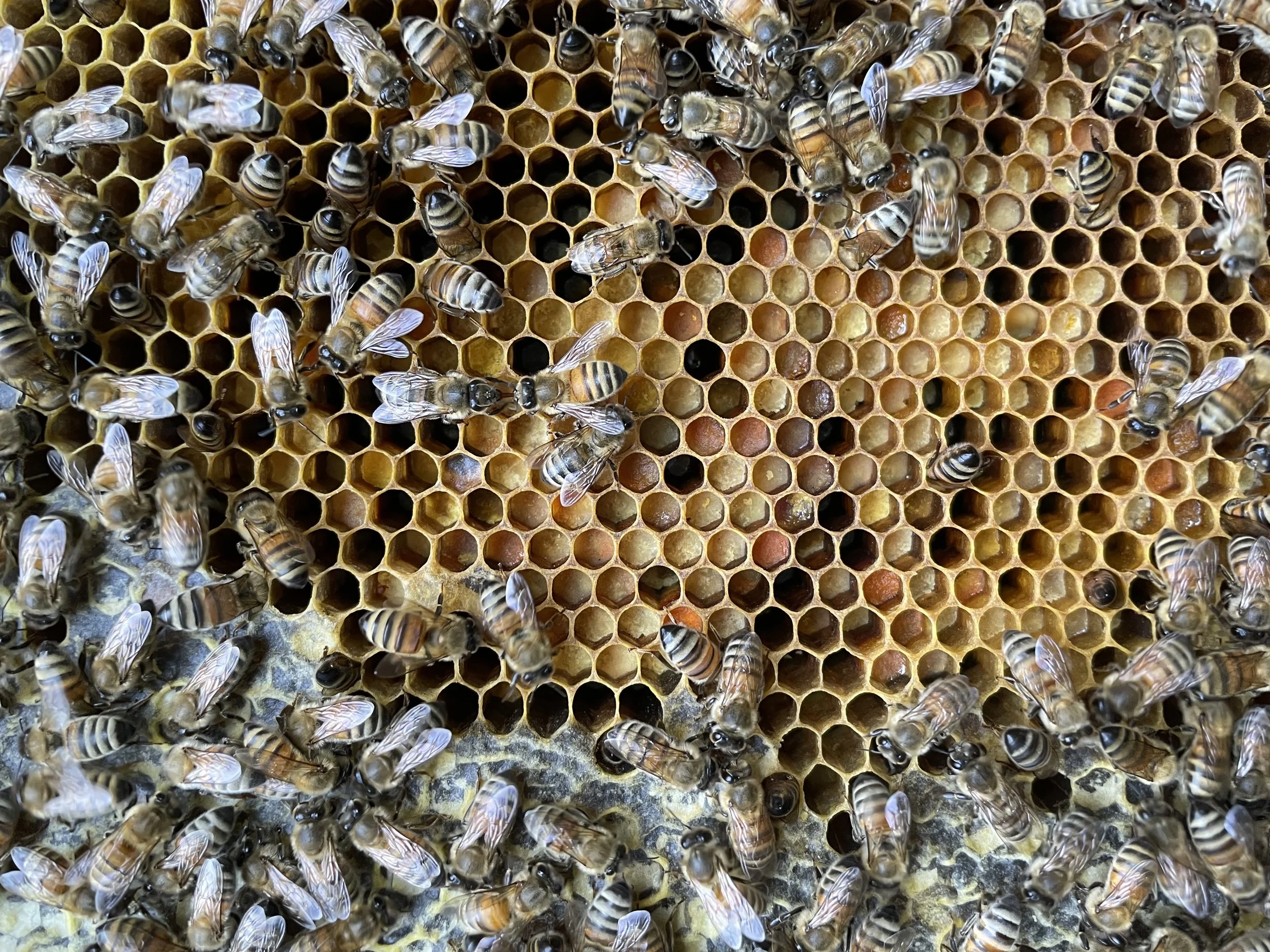
Pollen or “Bee Bread” stored inside the hive
The takeaway: when you’re evaluating a yard, look up and look out. What’s flowering on the next block? What’s the tree canopy like? Are there gardens, parks, or greenways nearby? In the NC Piedmont, the mature canopy of older neighborhoods does a lot of quiet work. Tulip poplar trees alone produce the biggest single nectar flow of the year here, peaking in April and May.
We’ve written more about the specific plants that support a healthy hive in our guide to native plants for North Carolina yards. For this post, the principle is enough: forage is what the colony actually eats. Everything else is logistics.
How much sun does a hive need?
Direct morning sun is what we look for, and at least six hours of total sun across the day. Bees can’t fly until their flight muscles are warm enough. A hive that catches the early light gets the colony out foraging sooner, and that compounds across a season. East-facing entrances are ideal. North-facing entrances we avoid.
The other half of this is shelter from afternoon heat. NC summers don’t go easy on a hive baking in full unobstructed sun all day. We look for placement that catches morning light but has some tree shade or a structure breaking the worst of the late-afternoon exposure.
If your yard has both — morning sun, afternoon dappling — you have one of the most important pieces already in place.
Where in the yard should the hive actually go?
The simple answer: in a quiet corner, oriented so the bees fly up and away from foot traffic. We need about five feet of clear space in front of the hive entrance for the bees’ flight path, and three to five feet behind for the beekeeper to work during inspections. That’s it. Most yards have these dimensions available; the real question is whether the spot also satisfies the sun, forage, and human-factor criteria.
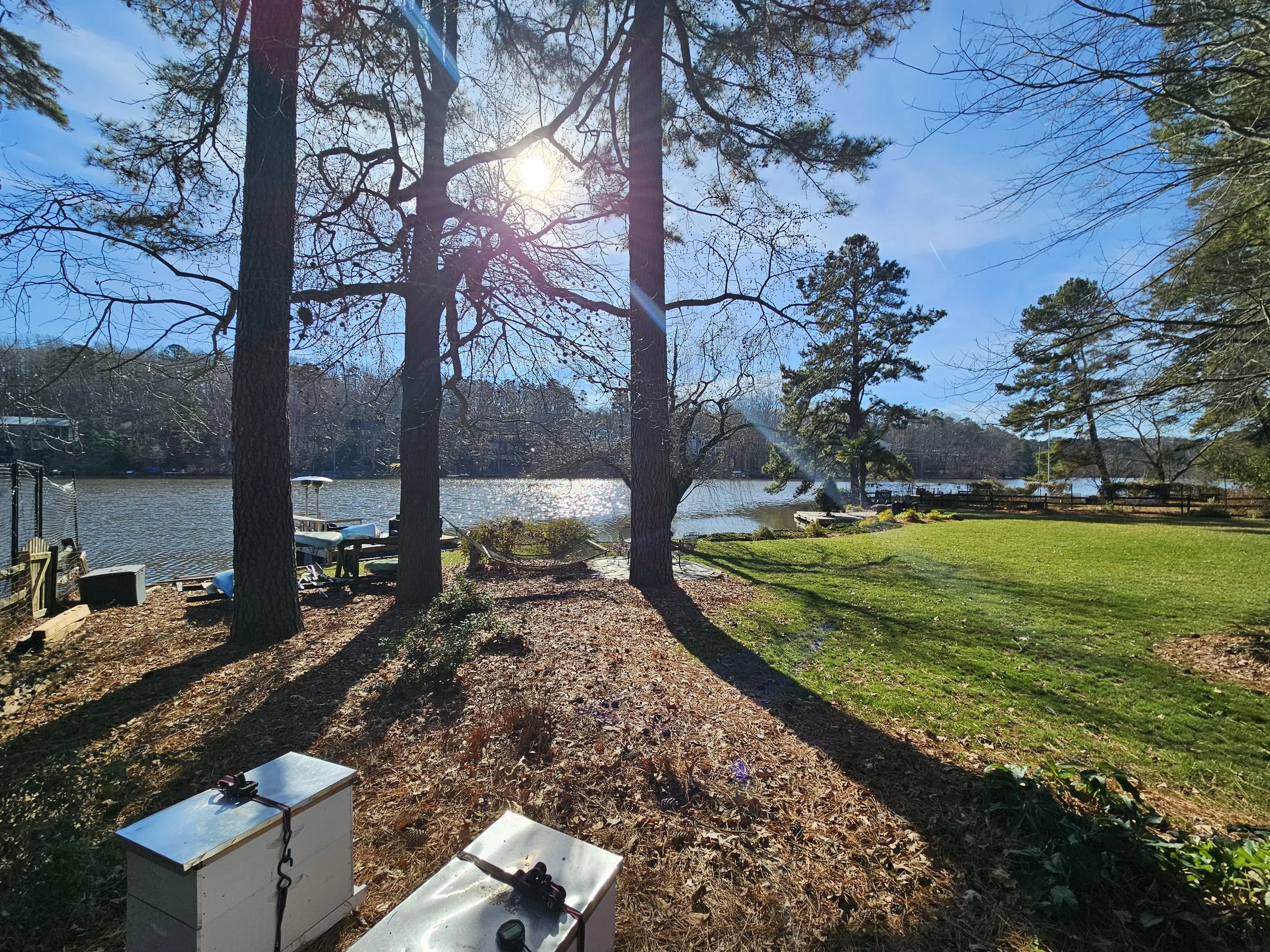
A managed beehive sited along a back fence line in a residential yard
Practical placements we use regularly:
Tucked along a back fence line — the fence becomes a natural visual screen and the bees fly outward over the property line
Behind a raised garden bed or shrub row — the planting acts as a flight-path lift that gets the bees up and over before they’re at human height
In a quiet side yard or back corner — anywhere that isn’t the kid’s play area, the dog’s run, or the patio you actually use
What we avoid: anywhere the entrance points at a sidewalk, a driveway, a doorway, or a neighbor’s outdoor space. The bees aren’t trying to interact with anyone, but a hive whose entrance lines up with a daily walking path is asking for a problem that’s easy to prevent.
For more on the dimensions piece specifically, our post on how much space you need for a beehive goes deeper.
What about your neighbors?
In our experience, most neighbors don’t notice. A managed hive in the back of a yard, with the flight path oriented away, is genuinely unobtrusive. Many of our hosts find their neighbors only learn about the hive when they get a jar of honey at the holidays.
That said, two things are worth thinking about before you install: privacy from immediate neighbors (a screened back corner is better than an exposed one) and any rules your community might have. North Carolina state law generally protects residential beekeeping, but HOAs operate on their own contracts. If you have an HOA, it’s worth a look at the covenants. We’ll go deeper on the legal side in a future post.
What’s different about NC backyards specifically?
The honest answer is that the NC Piedmont is one of the easier climates in the country for backyard beekeeping. The active foraging season is long. Colonies are active from late February through November in most years. The spring nectar flow is unusually rich, anchored by tulip poplar trees that mature neighborhoods like Myers Park or older corners of Durham produce in volume. Compare that to a Boston backyard with a shorter active season and a different bloom shape, and the math on a productive NC hive starts to make sense.
The trade-off is summer. A bad placement in a Charlotte or Raleigh July is a worse problem than the same placement in a cooler climate. Heat management is real. The shade-and-sun balance matters more here than it would farther north.
Lot character varies more than people assume across the Triangle and Charlotte. We have hives doing well on small Dilworth urban lots that look almost too tight on paper, and hives thriving on spacious Ballantyne yards with room to spare. Both work, for different reasons. The diagnostic above doesn’t change between them. What changes is which factor is doing the heavy lifting. On a small lot, the surrounding blocks’ forage is carrying the colony. On a large lot, the host’s own plantings often are.
A backyard becomes part of a hive’s territory the moment a colony moves in. Most yards are bringing more to that relationship than their owners realize.
If you want to go deeper on the planting side, our guide to native plants for North Carolina yards is the natural next read. The Bee City USA list of the top 25 native pollinator plants for NC is a useful supplement. And if you’d like to see what hosting actually looks like across a season, follow us on Instagram — that’s where our beekeepers post the day-to-day reality from the field.