

Planting with Purpose: Native Plants for North Carolina Yards
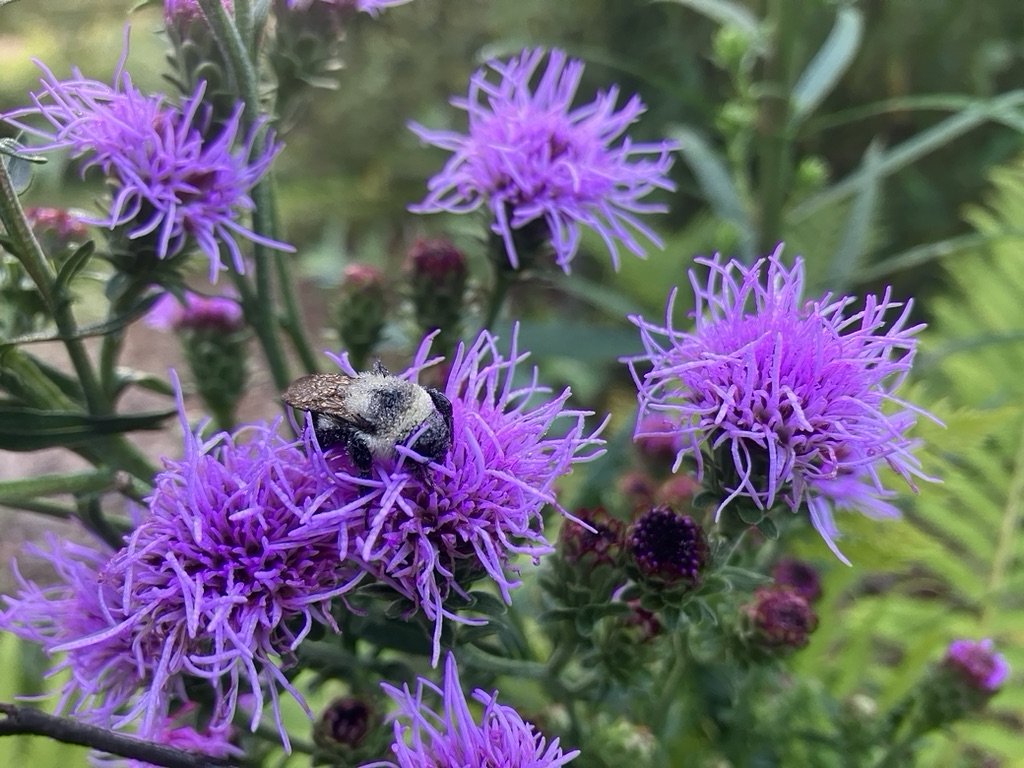
A native Bumblebee (Bombus sp.), asleep on a dew covered New England Blazing Star (Liatris novae-angliae) | ©2024 Owen Doll
Not all Plants are Equally Beneficial to a landscape
When you walk into the garden section of the hardware store or your local plant nursery, you are likely to see a striking and varied array of ornamental plants. These are species that many have come to know and love over the years, and it can be easy to assume that these showy flowers and shrubs can also help to feed pollinators and turn your yard into a space that is not only beautiful, but also beneficial to some of our local wildlife. But what if the general scientific consensus is growing in a different direction altogether? What exactly do these long-trusted ornamental plants do to a yard or garden?
As many as 90% of the plants that are available in the U.S. horticultural industry are non-native [1], and at best, these plants can severely damage the food webs of our caterpillars & songbirds [2][6], and at worst they may well be noxious invasives that damage the foundation of our ecosystems for many generations. One need only look at the massive swaths of kudzu in the Southern Appalachians, Japanese knotweed in the Northeast, or the near-ubiquitous patches of Japanese honeysuckle to see the potential damage of ornamental plants. But what options does this leave for the backyard gardener or urban resident who wants to support their local ecosystem while enjoying their own space?
Many people are quick to give their opinion on what plants you should or shouldn’t use in your garden/yard, and a quick google search will reveal an overwhelming amount of blogs and information. Needless to say, it can be a challenge to make sense of the confusing (and often incomplete) spread of information presented on the topic. But, there is no need to fret! In this article, we’ll present a framework that centers around native plants, and that will allow anyone to confidently approach their own pollinator garden or backyard project with environmental benefit in mind. We’ll also cover some of the important land use history of our area (Central NC and surrounding areas), and explore the fascinating world of native plant ecology!
Hanging By an Uncertain Thread: Three Centuries of Quiet Loss
North Carolina has long held a wealth of beautiful and varied natural landscapes. From the massively diverse western mountain ridge tops and moist cove forests, to the remarkable Sandhills region longleaf pine savannas, or the stunning coastal marshes with carnivorous plants and millennia-old cypress trees; this is a remarkable place to call home! But along with this natural beauty also comes a history of land use that has scarred the region, and it is essential to know some of this historical context if we are to steward our modern landscapes responsibly.
Beginning in the late 17th and early 18th centuries, colonial settlers pushed into the area we now know as central NC, bringing with them an agricultural land use methodology that has defined the state for much of it’s subsequent history as a tobacco, corn, and cotton producer. For more than 2 centuries, this farming had the unfortunate effect of widespread soil erosion that destroyed centuries worth of rich topsoil [4]. As worsening yields saw the state’s residents move away from agriculture in the 1930s and onwards, many acres of land were unintentionally or intentionally reclaimed and turned into the state’s familiar pine plantations, which could withstand these poor soil conditions.
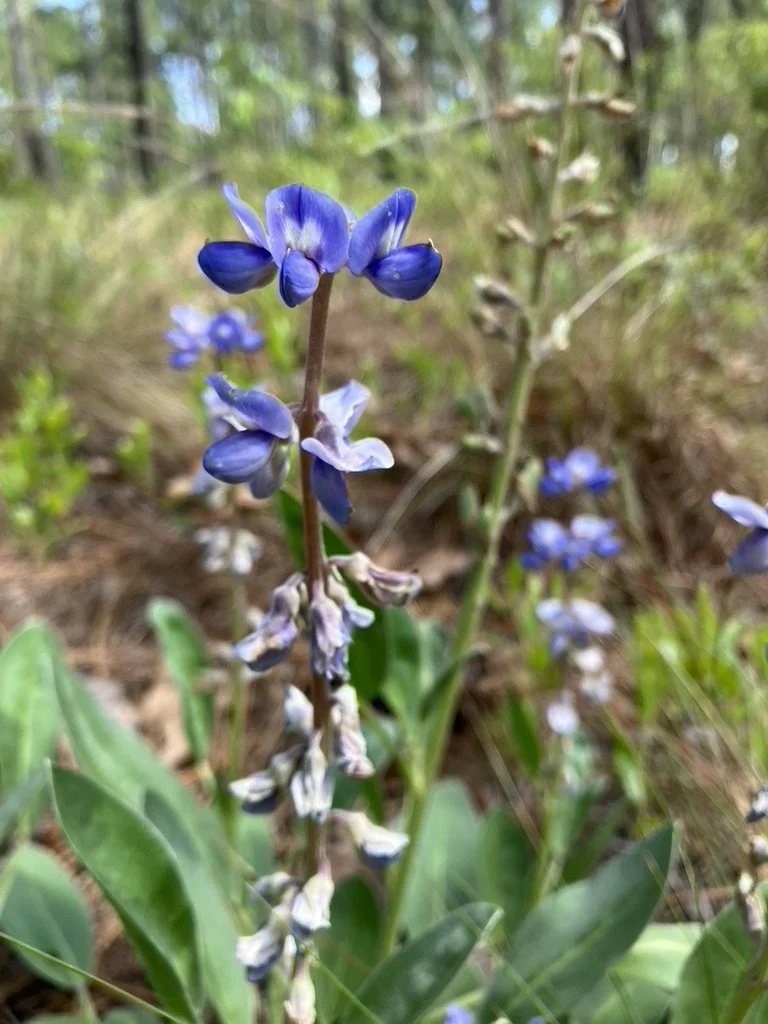
Photo is of a native Skyblue Lupine (Lupinus diffusus) in the NC Sandhills | ©2024 Owen Doll
At nearly the same time as this large scale reforestation, state and federal forestry services effectively removed natural wildfires from NC’s landscapes in a management strategy that has persisted for the last century. The combined effect of these shifts created “wild” landscapes in much of central NC that look remarkably different from the lush Piedmont prairies & open pre-contact savanna-like forests that once dominated the area [4], and which certainly had the effect of massively reducing the biodiversity of native organisms.
Making The Case For Planting Native
Although unfortunate, we can learn much from these historical practices about how to instead help create truly healthy and resilient natural spaces on any scale. Even if you’re just working with a small yard in the suburbs, one of the overwhelmingly clear principles we can glean is that our native plants can be incredibly beneficial!
We can also see this with a variety of recent research that backs up these historical patterns: take for example the work of Dr. Doug Tallamy, who has spent many years researching the massive benefit that particular native plants can have on backyards. In his work with Carolina Chickadees, Doug and his team found that suburban yards with more than a 30% biomass of non-native plants experienced a decrease in available food and an almost complete inability for Chickadees to nest and reproduce at sustainable rates [6]. The underlying story of these figures spreads beyond just chickadees, and suggests the potential for a catastrophic loss of insect and bird biodiversity if landscaping practices don’t shift towards native plants.
Another product of Tallamy’s work is an incredible tool for gardeners and nature lovers: the National Wildlife Federation’s Native Plant Finder, which allows anyone to enter their zip code, and receive a list of the most beneficial plants to use in your landscape, ranked in the order of the amount of insects (specifically butterflies and moths, as they’re the primary source of food for songbirds during breeding season) that use them as hosts. In the words of Tallamy and his colleagues, “properties landscaped with non-native plants function as population sinks for insectivorous birds. To promote sustainable food webs, urban planners and private landowners should prioritize native plant species.”
The Devil is in the Details
It is also important to see how even using only native plants can do damage, as we see with our extensive pine plantations. Loblolly pine (Pinus taeda) timber plantations occupy over 2.5 million acres of North Carolina [10], which is over 12.5% of our landmass, and larger than all of the state’s national forests combined. The management strategies frequently used in these ‘tree farming’ systems can shed some light on our quest for nuanced information on how humans can positively and negatively impact their landscape.
Although loblolly pines are native, they are often encouraged in commercial settings to grow in near monoculture groves of densely spaced trees without healthy topsoil. These combined factors tend to create a forest that is extremely limited in its wildlife benefit. Instead of a rich and diverse understory of uncommon herbaceous plants, you have a dark & uniform blanket of pine straw that may support only a dozen or so species of shade tolerant plants that can grow in poor soil. This is one of many prime examples of the fact that nuance and context are vitally important; yes, loblolly pines are native, but the way they’re managed often creates sub-optimal wildlife habitat [8]. The same considerations are what can turn a relatively standard yard into a haven of important keystone plant species that support massive amounts of wildlife!
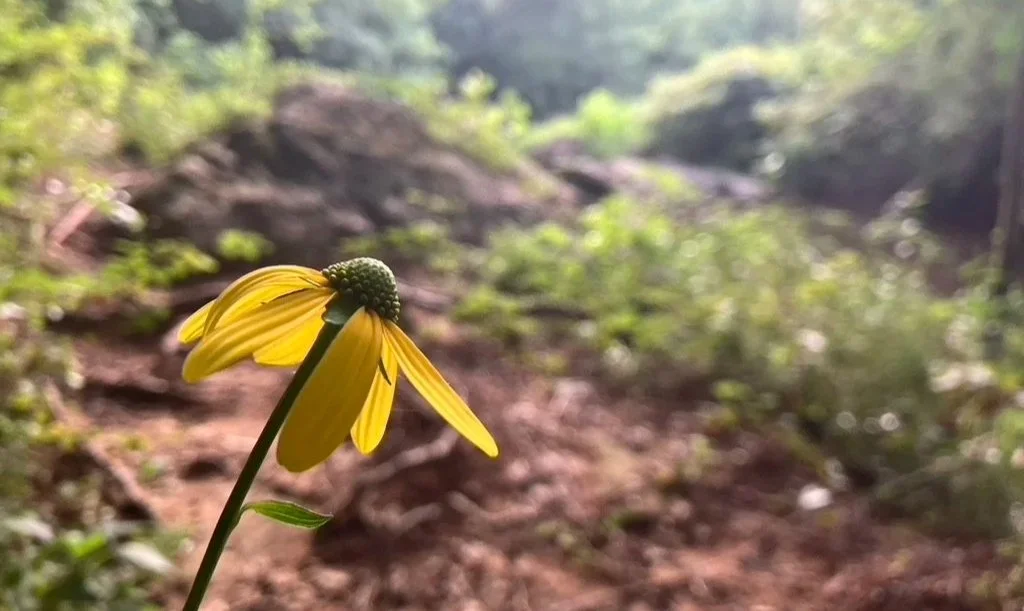
Green-Headed Coneflower (Rudbeckia laciniata) blooming on the banks of the Eno River | ©2024 Owen Doll
Native Plant List For The NC Piedmont
Without any further ado, let’s cover some of the most promising native plants that can thrive in the Piedmont region while providing plenty of ecological benefit! These will be split into categories based on their growth form (trees, vines, herbs), as it can be helpful when trying to decide what plant may be a good fit for replacing a non-native plant you may already have. This list is not exhaustive by any means, but includes many of the more common plants that are readily available at specialized native plant nurseries and seed companies, and a list of preferred nurseries and seed suppliers for central NC will be given below the plant list.
Herbaceous Plants/ Wildflowers
Goldenrods (Solidago spp.)
Goldenrods support over 100 species of butterfly and moth caterpillars in our area, and it only takes a quick look at their blooms to see the massive amount of pollinators that rely on them. Many dozens of species are native to NC, and it’s hard to go wrong with any! That being said, some of our personal favorites are:
Zigzag Goldenrod (S. flexicaulis); Drought resistant and very shade tolerant for more wooded areas.
Showy Goldenrod (S. speciosa); Rightfully esteemed for it’s beauty, drought tolerant and likes sunnier locations.
Wrinkle-leaved Goldenrod (S. rugosa); A great option for wetter areas with plenty of sunlight.
*all species mentioned are quite deer resistant!
Joe-Pye Weeds (Eutrochium fistulosum & purpureum)
These tall, clumping perennials are distinct for their large pink flowering heads that are loved by Eastern Tiger Swallowtail butterflies. Extremely adaptable to a variety of soil moisture levels, with a preference for partial or full sun. A good option for prairie plantings where deer resistance is paramount.
Blazing Stars (Liatris spp.)
Our native blazing stars have gorgeous purple flowers that are invaluable nectar sources throughout late summer and autumn. All species are relatively drought tolerant with a preference for drier soils, and usually prefer as much sun as possible. Not very deer resistant.
Dense Blazing Star (L. spicata); One of the most moisture tolerant liatris species we have. Dense blooms on stalks up to 6’ tall
Scaly Blazing Star (L. squarrosa); A shorter (up to 3’) species with a preference for sandy or rocky soils.
Grass-leaf Blazing Star (L. pilosa); This short species is common in the Sandhills, and would be a great fit for a pocket prairie.
Button Blazing Star (L. aspera); This plant is one of few that will thrive in poorer soils! Blooms are spread out on the flowering stalk.
Asters (Symphyotrichum spp.)
With roughly 3 dozen species native to NC, there are a massive variety of these to choose from. Their flowers offer huge value to many of our native pollinators, and there are several options for each set of soil and sunlight conditions a gardener may encounter. Species like Georgia Aster (S. georgianum), Eastern Silvery Aster (S. concolor), New England Aster (S. novae-angliae), and Late Purple Aster (S. patens) offer stunning flowers, with many others providing an even greater variety of blooms and garden intrigue. Find those species that fits your particular conditions, and watch for the suite of native insects they attract!
New York Ironweed (Vernonia noveboracensis)
This is a thoroughly under-appreciated native plant with stunning deep purple late-summer blooms! Ironweed is often found on wet roadsides and along river floodplains in our area, and has a preference for soils that aren’t too dry. It handles heavy clay soil well, and is relatively deer resistant.
Rudbeckias (Rudbeckia spp.)
These sunflower-like wildflowers come in several varieties that are native here in NC, and offer flowers that are exceptionally attractive to many of our native butterflies and bee species. They are consistently preferring of partial or full sun exposure, and often quite deer resistant.
Black-eyed Susan (R. hirta); A mainstay of pollinator gardens across the U.S., with a short growth form and striking flowers that offer strong deer resistance and notable pollinator support. Consider also the similar and less common Brown-eyed Susan (R. triloba).
Green-headed Coneflower (R. laciniata); A delicious traditional potherb of the Cherokee people, this plant is somewhat common in pollinator plantings for good reason. Gets to 6’ tall in the sun, and can form large hardy patches after a couple years.
Sunfacing Coneflower (Rudbeckia heliopsidis); An especially rare species that is sometimes available form nurseries, and would benefit greatly from careful tending! Likes full sun and average soils.
Orange Coneflower (R. fulgida); this NC native’s orange leaning bloom color sets it apart; otherwise similar to black & brown-eyed susans.
Blue Mistflower (Conoclinium coelestinum)
This is a charming late summer and autumn blooming plant with vivd blue flowering heads like no other, and is one of my personal favorite wildflowers to find in wild prairies and meadows here in NC! This plant is extremely tough & resilient, and spreads quite a bit when given its preferred full sun exposure. Relatively deer resistant, and is amenable to most soil moisture levels.
Coreopsis (Coreopsis spp.)
Our coreopsis species are essential prairie habitat plants that attract a variety of obligate specialist native bees. Generally prefer less rich soils and full sun, except for Woodland & Pink Coreopsis. Quite deer resistant as well!
Large-flowered Tickseed (C. grandiflora);
Lance-leaf Coreopsis (C. lanceolata);
Thread-leaf Coreopsis (C. verticillata);
Woodland Coreopsis (C. major);
Pink Coreopsis (C. rosea);
Milkweeds (Asclepias spp.)
It is hard to overexaggerate the benefit of milkweed to a landscape, and NC’s several native species options provides a large spread of characteristics for varying soil and light conditions. Milkweeds are veritable pollinator powerhouses, and are a rightfully popular garden mainstay in ecologically conscious landscaping.
Common Milkweed (A. syriaca); A popular choice for pollinator gardens, this aggressive perennial forms colonial patches as it spread via its roots, and does best in areas where it’s spreading habit won’t intrude.
Butterfly Weed (A. tuberosa); The vivid orange flowers of Butterfly weed are unrivaled in NC. Prefers dry soils and full sun. Also not too aggressive like common milkweed often is.
Poke Milkweed (A. exaltata); Much daintier than common milkweed, and prefers richer and wetter soil than it’s cousins. Prefers dappled sunlight and is a great choice along forest edges.
Swamp Milkweed (A. incarnata); Purple flowered species that is less aggressive than common milkweed, and adaptable to moderate soil moisture (despite its name).
*all species mentioned are quite deer resistant!
Evening Primroses (Oenothera spp.)
Evening Primroses are extremely important moth and butterfly host and nectar producing plants, with a variety of options available depending on desired growth patterns and conditions. Beautiful and distinct yellow 4-petaled flowers are standard amongst this genus in NC.
Common Evening Primrose (O. biennis); A tall, sun loving plant that spreads aggressively if unchecked. Perfect for edges of woods or for use in areas where spreading is less of a concern than a standard garden.
Southern Sundrops (O. fruticosa); tolerant of dry, thin soils, but will do well in richer garden conditions. Less aggressive spreader than O. biennis
Northern Sundrops (O. tetragona); more shade tolerant than southern sundrops, but similarly short and well-behaved
Cardinal Flower (Lobelia cardinalis)
A stunning wildflower with a unique crimson color that is primarily pollinated by the Ruby-throated Hummingbird! Found in the wild along stream banks and in wet areas; prefers wet/ average soil & partial/ full sun exposure.
Fire Pink (Silene virginica)
Fire Pink’s striking crimson springtime flowers are hard to miss, and this hummingbird pollinated plant is one I always relish the chance to see in the wild. This plant is unique due to its tolerance of drier, rocky soils and partial shade.
St. John’s Wort (Hypericum spp.)
With conspicuous yellow flowers that herald the beginning of summer, St. Johns Worts host nearly 2 dozen NC caterpillar species and offer a massive variety of growth forms amongst our nearly 30 native species. A couple select species are listed below, but feel free to choose amongst our many native options!
Spotted St. John’s Wort (H. punctatum); The preferred alternative to the invasive European St. Johns Wort (H. perforatum). prefers wetter soils and lots of sun.
Shrubby St. John’s Wort (H. prolificum); Technically a small shrub, and is very adaptable to soil and light variation.
Bushy St. John’s Wort (H. densiflorum); Uncommon, and has a preference for wet soil and lots of sunlight. Could likely benefit from being propagated due to it’s rarity and population decline due to habitat loss.
Rattlesnake Master (Eryngium yuccifolium)
A strikingly unique deer resistant pollinator plant that is particularly favored by our native wasp species. Those attracted wasps can greatly reduce garden pest pressure due to the presence of these beneficial predators! Can handle dry or wet soils, but generally requires lots of sunlight.
Honorable Mentions
With nearly 3,000 species of wildflowers in NC alone [14], it’s hard to choose only a handful here to talk about. The above list is best used as a starting point from which to learn more about our incredible collection of wildflowers. I also recommend taking a look at some of the following species:
Spring ephemerals like Trout Lily (Erythronium umbilicatum), Spring Beauty (Clayton virginica), Bloodroot (Sanguinaria canadensis), Trilliums (Trillium spp.), can be an exceptional addition to a more forested yard or property.
Other wildflowers like Green & Gold (Chrysogonum virginianum), Carolina Ponysfoot (Dichondra carolinensis), Mountain Mints (Pycnanthemum spp.), Boneset (Eupatorium spp.), Wild Strawberry (Fragaria virginiana), Wild Geranium (Geranium maculatum), native Sunflowers (Helianthus spp.), Beebalms (Monarda spp.), & Wild Phloxes (Phlox spp.) are all well worth the consideration of an enterprising native plant gardener!
Shrubs & Small trees
Dogwoods (Cornus & Swida spp.)
With over 100 species of caterpillars using our dogwood species as host plants, it doesn’t take long to see their potential benefit! Varying from trees to small woody shrubs, their lovely flowers and distinct foliage offer invaluable insect support, with the downside of being browsed frequently by deer.
Florida Dogwood (Cornus florida); A small tree at maturity, that happens to be NC’s state flower! A common and venerable species that certainly belongs in our state’s landscapes.
Silky Dogwood (Swida amomum); Preferring wet soil and at least some sun exposure, this native shrub is great for stabilizing wet areas.
Alternate-leaf Dogwood (Swida alternifolia); This shrubby species has distinctive green bark and colorful fall foliage, and its native range extends from the mountains just into the Piedmont.
Swamp Dogwood (Swida foemina); This uncommon wetland shrub certainly deserves more attention, and has great potential for fans of rarer plant species.
Hollies (Ilex spp.)
Our hollies are incredibly valuable plants for their pollinator and insect support, with nearly 50 species of caterpillars using it as a larval host. They are also highly deer resistant, usually evergreen, and the species below are on the smaller size for easier use in backyard landscapes.
Inkberry Holly (I. glabra); A characteristic holly of the Atlantic coastal plains that is fond of sandy soils, and tolerant of partial shade.
Possumhaw (I. decidua); Common in our floodplain forests, and deciduous similar to winterberry.
Yaupon Holly (I. vomitoria); The only caffeinated plant in North America, this is somewhat common in landscaping due to its hardy nature. A great choice for the backyard!
Winterberry (I. verticillata); The one included species that is deciduous, due to it’s more northern native range than the others.
Buckeyes (Aesculus spp.)
These distinctive shrubs are indicative of some of our most sensitive and beautiful riverbank forest habitat in the Piedmont, and are striking when in bloom in the spring and summer. They are deer resistant, shade tolerant, and prefer at least some soil moisture.
Red Buckeye (A. pavia); A somewhat popular ornamental in its own right, and a great native option with stunning red flowers.
Painted Buckeye (A. sylvatica); A distinctive and characteristic plant of the NC Piedmont with beautifully understated flowers. My personal favorite, and should be used more frequently in landscaping!
Bottlebrush Buckeye (A. parviflora); Native range is primarily in the Deep South, but nonetheless beneficial and worth planting.
Elderberry (Sambucus canadensis)
Elderberry is an increasingly common herbal medicine for viral infections, but is also a gorgeous and resilient native shrub that is well suited to moist or wet soils and plenty of sunlight! This is an important host plant for ~30 caterpillar species & various native beetles.
American Hazelnut (Corylus americana)
American hazelnut is a lesser appreciated powerhouse caterpillar host plant, supporting just over 100 species! It is a blight resistant hazelnut with delicious edible fruit and a graceful growth form that is well suited to average soil conditions and partial to full sun. It is deer resistant as well.
Serviceberries (Amelanchier spp.)
With 8 native species to choose from, I’ll refrain from listing them as they’re all relatively similar (their differences mostly appear in their height and mature size). This is another prolific caterpillar host, supporting just over 90 species, while providing delicious edible fruits that taste like a cross between an apple and blueberry!
Carolina Rose (Rosa carolina)
While we do have a few native NC rose species, this is one I’ll highlight due to it’s availability. It has large edible fruits, beautiful showy flowers, and does well with ample sun and moist soil (although is drought resistant once established). Moderate deer resistance, and the potential to host over 100 NC caterpillar species!
Blueberries (Vaccinium spp.)
Our familiar grocery store blueberries are direct descendants of our wild varieties; with a wide variety of growth forms and ~14 native species to choose from, the cherry on top is that these shrubs support well over 200 caterpillar species as host plants! Generally prefer acid soil and moderate to full sun exposure.
Honorable Mentions
A variety of fantastic woody plants didn’t make it onto the full list that deserve some mention: Cherries (Prunus spp.), Willows (Salix spp.), Viburnums (Viburnum spp.), Buttonbush (Cephalanthus occidentalis), and Hawthorns (Crataegus spp.) each support a massive amount of caterpillars as host plants, and accordingly have an especially beneficial effect for local wildlife.
Others like Redbud (Cercis canadensis), Northern Spicebush (Lindera benzoin), Wild Hydrangea (Hydrangea aborescens), and Ninebark (Physocarpus opulifolius) offer slightly less caterpillar host plant utility, but have prolific & beneficial blooms for native pollinators.
Vines
American Wisteria (Wisteria frutescens)
This lesser-known native species closely resembles the commonly invasive Chinese Wisteria (Wisteria sinensis), but lacks the highly aggressive growth habit while still lending beautiful purple clusters of spring-blooming flowers. It is quite deer resistant, and has a preference for full sun and moist soils.
Coral Honeysuckle (Lonicera sempervirens)
As a native alternative to Japanese Honeysuckle (Lonicera japonica), this small woody vine wholly outshines its invasive counterpart with its slender red flowers. A hummingbird favorite, this dense-growing vine is adaptable to a variety of light conditions, and prefers moist soil.
Passionflower (Passiflora incarnata)
This native vine is like no other, with fast growing growth form and stunning large flowers that are a favorite of carpenter bees. Although it dies back to the ground each winter, this tenacious native shouldn’t be underestimated and should be kept where easily contained. Likes full sun and is adaptable to any sort of soil moisture. The ripe fruits are one of my favorite wild foods.
Wild Grapes (Vitis spp.)
Our native wild grapes are and incredible resource for wildlife due to their edible fruit, as well as their capacity for hosting over 60 local caterpillar species. With several species to choose from and a resilient habit, this is a great choice for its high capacity for wildlife benefit.
Virginia Creeper (Parthenocissus quinquefolia)
This is an extremely common plant in our area, enough so that it is almost funny to mention it here! But due to its reputation as a weed, I wanted to talk on this plant’s incredible benefit: It supports nearly 30 species of caterpillar in our area, and also provides an enormously valuable fruit that is conspicuously visible and attractive to fall migrating songbirds who require a high fat diet for their journey.
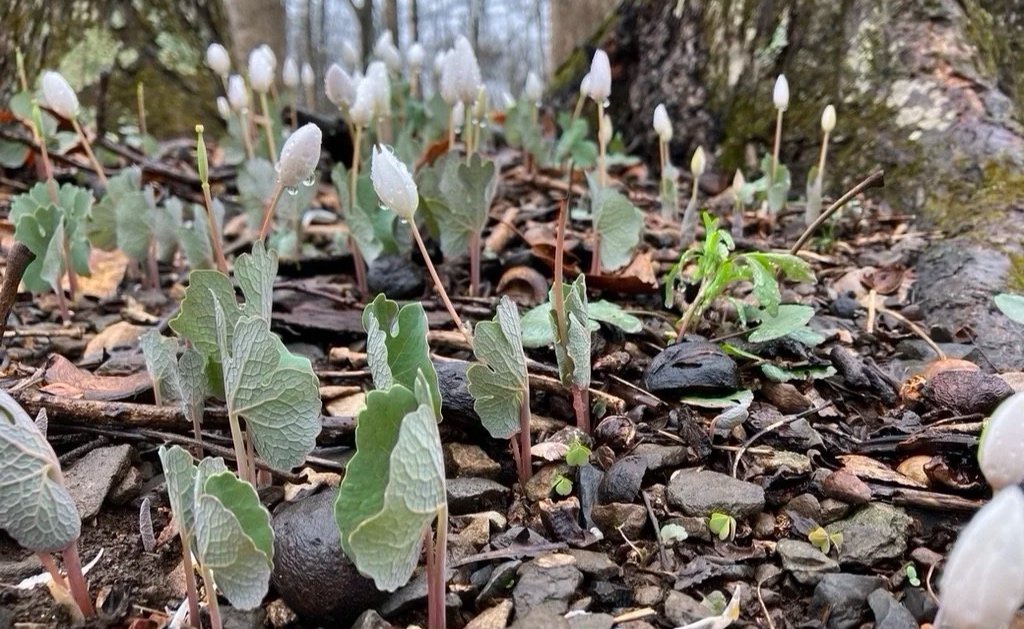
Emergent Bloodroot (Sanguinara canadensis) flowers and leaves in the mountains of central Virginia | ©2023 Owen Doll
Resources
The journey of learning about and using native plants is along and rewarding one to be sure. For those in and around the Triangle area of NC, the following list of resources should prove helpful in tackling a native garden/ landscaping project of any scale, or simply learning more about our unique ecology!
Nurseries and Seed Companies
Garrett Wildflower Seed Farm in Smithfield offers a variety of local ecotype seeds that are excellent for making pocket prairies
Flower of Carolina Nursery is a stellar nursery in Saxapahaw that offers a massive variety of common and rare local native species
Knotty By Nature is an arborist and nursery in Durham that offers a some very unique & hard to find native plants
Rachel’s Natives Plants in Pittsboro offers a huge variety of rarer native species, and is a wonderful option
Deep Roots Natives in Durham is conveniently located in the triangle with a retail store that is open most days of the week
The NC Botanical Gardens in Chapel Hill have some plants consistently available, as well as more involved spring and fall plant sales
Laurel’s Garden Designs and Fifth Season Gardening in Raleigh have native plants for sale, with the latter being open every day of the week
For a more exhaustive list, check out the NC Native Plant Society Nursery List; its a very detailed list of nurseries throughout the state that should give plenty of options!
Other Plant Lists and Guides
The National Wildlife federation’s Native Plant Finder is an incredible resource for finding beneficial caterpillar host plants in any area!
Xerces Society: Native Plants for Pollinators and Beneficial Insects (Mid-Atlantic)
References
https://aiph.org/floraculture/news/native-plants-are-on-the-rise/
https://esajournals.onlinelibrary.wiley.com/doi/10.1890/ES10-00032.1
https://www.srs.fs.usda.gov/pubs/gtr/gtr_srs071/gtr_srs071-vanlear001.pdf
https://content.ces.ncsu.edu/landscaping-for-wildlife-with-native-plants
https://www.ncagr.gov/divisions/nc-forest-service/SRN7/download?attachment
https://headwaterseconomics.org/natural-hazards/federal-wildfire-policy/